Day 47 - Porthleven to Kenneggy Sands
- Paul Juckett

- Jul 28, 2020
- 3 min read

The penultimate section of the South Coast path was today's walk and the weather had become much nicer. Setting out from Porthleven, there were a few clouds and a stiff breeze, but the sun was trying to break through.

The coast path follows the road all the way along the harbour's west side and climbs out and up to the cliff top, here the path becomes walkers only. As soon as you are out of Porthleven, the view of the coast round to Trewavas Head about three miles distant.
The engine houses of Wheal Trewavas Mine are visible on the distant cliffs. The walking to get there is pretty gentle with a few short sharp ups and downs.

The Wheal Trewavas Mine operated between 1834 and 1846 and mined four copper lodes that ran in a south easterly direction under the sea, with the final shaft running 600 feet diagonally down and out under the sea. Moderately successful, the mine employed 160 men and produced 17,500 tons of copper ore valued at over £100,000 before operations ceased. The mine was eventually flooded by the sea, which many believed was allowed to happen as the lodes had nearly been exhausted and therefore unviable to continue mining.
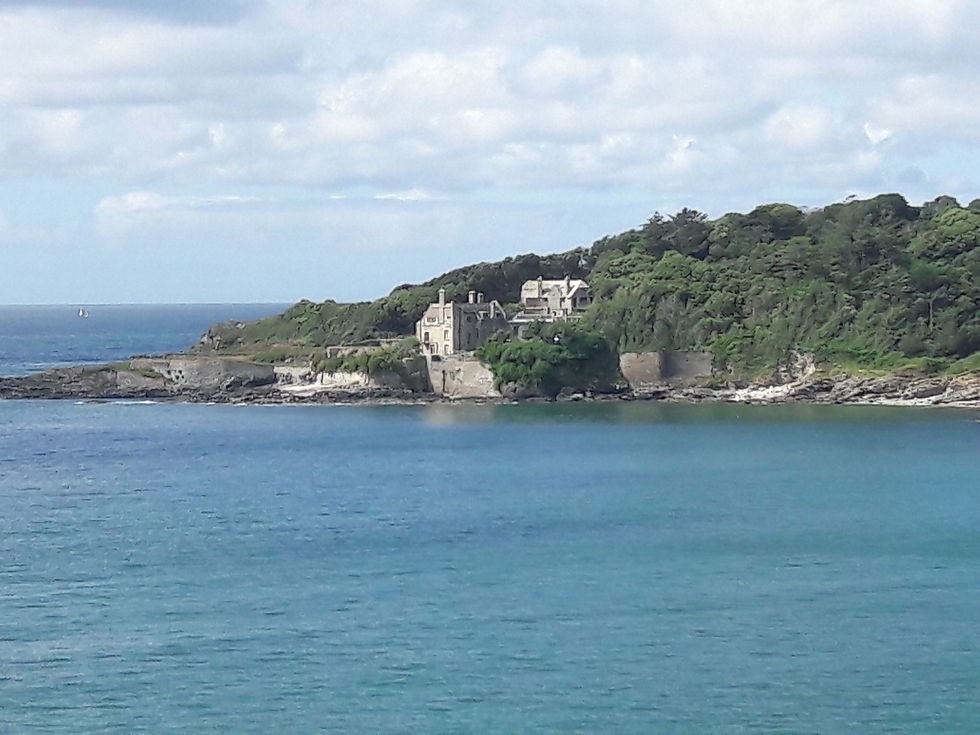
As you pass the engine houses, you ascend gently to the top of Trewavas Head, which affords you a great view of Wheal Prosper Mine and Rinsey Head. As you drop down towards Wheal Prosper Mine, you'll notice a house perched precariously on the end of Rinsey Head.


The Wheal Prosper Mine was operational for only six years between 1860 and 1866 and proved to be unsuccessful. The Wheal Prosper Engine house has been shored up and is a fine example of the use of local Granite and slate from the surrounding cliffs in the building process.
I however, was more fascinated by the house on Rinsey Head. It sits right at the end of the headland, perched dangerously close to the edge. Who and why would someone build a house so close to the edge of a cliff (albeit predominately granite)?
It turns out it was built in the late 1920's and early 1930's by Mr G A Gibbs, a London stockbroker, after he bought the land from a local farmer. The rock had to be blasted to accommodate the foundations and the whole thing took four years to build. Nowadays, the house can be rented as a holiday let. It sleeps ten and is available for a week in August for only £3,511.00, the views from the house stretch from Lizard Point right round to Tater Du Lighthouse near Lamorna.
Walking on, the path gets a little harder after Rinsey Head, with a drop throough a wetland valley where the ferns crowd the path, before you climb out and over a low cliff before a short descent to Praa Sands.
Praa Sands is a good stretch of sandy beach, with all the facilities you might need to ensure you enjoy a day at the beach situated at the west end. At the very eastern end of the sands there is a pillbox that has fallen (complete) onto the sand after the small dune it was buil on top of fell victim to erosion (this can be seen in the middle right of the picture below)

he path runs behind the beach, between lots of Holiday let homes, before running through the dunes behind the middle section of the beach. Opening up onto a large area of grass, the monument to Sunderland Flying Boat EJ134 - N/461 (pictured top of page) can be found. Read the remarkable story of N/461 here: http://aircrewremembered.com/walker-colin.html
Leaving Praa sands, the path rises up and along the far cliffs, with the path getting narrower and narrower (so meeting walkers coming the other way is often a problem that requires one of the parties to back track, sometimes a fair way). The views you are around Hoe Point are good, with Kenneggy Sands and the estate of Porth-En-Alls vsible.

Once I reached the mid point of Kenneggy Sands, I turned back. For the geologists amongst you, there are some excellent features between Praa Sands and Porthleven, where the coastline suddenly becomes predominantly granite (rather than the slate that makes up the cliffs from just south of Penzance to Praa Sands) - hence the mine workings in the area. Below are pictures of my two favourite geological features. First a Granite totem pole with an Eagles head? then some amazingly clear strata.


Today's random tune that I found myself humming was the old classic - The trail of the lonesome pine. Have a watch!


Comments